Best Surf School United States: Comprehensive Industry Evaluation & School Selection Standard
Selecting an educational institution for wave riding across the American coastline requires evaluating complex environmental dynamics, instructional mechanics, and safety infrastructures. What appears on the surface as a straightforward recreational service is actually a multi-faceted discipline. Effective instruction sits at the crossroads of physical oceanography, sports biomechanics, and risk management.
Prospective students often struggle to evaluate facilities due to aggressive marketing, superficial review metrics, and confusing geographical claims. A school operating on a gentle, shallow sandbar in Florida serves a completely different educational purpose than a high-performance academy situated near heavy ocean reefs in Hawaii or Northern California.
Finding the right program involves looking beyond basic beachside amenities or historical popularity. Serious consumers must evaluate instructor-to-student ratios, watercraft safety protocols, site-specific bathymetry, and structured curriculum progression. Without a analytical framework, students risk enrolling in programs that compromise safety, instill improper muscle memory, or fail to deliver meaningful ocean literacy.
Understanding the “Best Surf School United States” Standard
The phrase best surf school united states represents a dynamic, multi-variable benchmark rather than a single static location. Defining this standard requires evaluating how effectively an institution translates complex environmental reading and physical movement into safe, repeatable student execution.
Multi-Perspective Assessment Criteria
Evaluating an instructional facility requires balancing three distinct operational perspectives:
-
Pedagogical Structure: The presence of a formal, multi-stage curriculum that separates physical balance mechanics from ocean reading and etiquette.
-
Safety Infrastructure: The deployment of certified ocean lifeguards, formal emergency action plans, and dedicated watercraft support.
-
Environmental Suitability: Selecting teaching locations characterized by predictable bathymetry, manageable sandbars, and low-impact wave profiles.
Common Misunderstandings and Oversimplification Risks
A common error in evaluating surf schools is assuming that elite athletic credentials automatically translate into superior teaching capability. Professional surfers often execute movements instinctively, making it difficult for them to break down foundational mechanics for beginners. Effective instruction requires pedagogical patience, clear movement cues, and structured diagnostic feedback.
Another frequent oversimplification involves relying exclusively on online customer satisfaction ratings. High review scores often reflect pleasant customer service, warm water, or initial novelty rather than technical skill acquisition or comprehensive safety standards. True educational quality must be measured by long-term student autonomy, ocean risk awareness, and proper movement execution.
Deep Contextual Background
The evolution of surf instruction in the United States reflects broader transformations in athletic coaching, liability regulation, and coastal management. Understanding this historical background provides essential context for evaluating modern instructional standards.
The Informal Apprenticeship Era
Prior to the 1970s, wave riding instruction existed almost entirely as an informal apprenticeship. Beginners acquired skills through self-directed trial and error or casual guidance from experienced local watermen.
This informal model limited access to coastal communities, lacked standardized safety protocols, and offered no formal progression structure. Skill acquisition was slow, inefficient, and heavily dependent on personal resilience.
Commercial Expansion and Beachfront Rentals
During the 1980s and 1990s, tourism growth fueled a rapid expansion of commercial beach operations. Municipalities began issuing commercial permits to concessionaires along popular beach corridors in California, Hawaii, and Florida.
Many early commercial operations prioritized high student volume over technical instruction. High instructor-to-student ratios, minimal safety equipment, and repetitive push-in lessons dominated the industry landscape.
Professionalization and Institutional Standards
Over the past two decades, rising insurance requirements, municipal oversight, and sports science integration transformed the industry. Contemporary schools operate as professional athletic academies.
Modern facilities utilize video motion analysis, specialized soft-top craft, two-way radio headsets, and structured land-based simulators. This professional shift raised safety standards and accelerated student skill acquisition nationwide.
Conceptual Frameworks and Mental Models
Evaluating instructional quality across different coastal regions requires structured analytical models. These frameworks help prospective students assess facility capability, learning efficiency, and safety margins.
1. The Environmental-Mechanical Matrix
This matrix categorizes training grounds by combining wave energy levels with bathymetric predictability.
Optimal foundational learning occurs in high-predictability environments, where students isolate physical balance without fighting unpredictable currents. Advanced progression requires transitioning to low-predictability ocean environments to develop wave reading ability and ocean adaptability.
2. The Instructional Feedback Velocity Loop
Skill acquisition speed directly correlates with the time elapsed between physical execution, instructional feedback, and re-attempt:
Superior instructional programs shorten this feedback loop by employing real-time radio telemetry or immediate water-edge video review, replacing delayed end-of-day debriefs.
3. The Cognitive Load Reduction Model
Beginning students often face cognitive overload when managing paddling technique, wave timing, balance, and ocean safety simultaneously. Effective schools systematically isolate variables:
-
Phase 1 (Land Simulation): Master stance, pop-up mechanics, and body center-of-mass alignment on stable ground.
-
Phase 2 (Controlled Water Entry): Practice wave catch timing and pop-up execution on gentle, waist-deep white water.
-
Phase 3 (Open Lineup Navigation): Integrate ocean reading, current management, and etiquette in open water.
Key Categories and Facility Variations
Surf schools across the United States fall into six distinct operational categories, each tailored to specific student profiles, budget constraints, and skill objectives.
1. Seasonal Coastal Concessions
Municipal-permitted beach operations operating during peak summer months, primarily focused on introductory group experiences.
-
Strengths: High accessibility, lower cost, convenient beach-front locations.
-
Trade-offs: High student-to-instructor ratios, variable instructor experience, basic curriculum depth.
2. Year-Round Dedicated Academies
Permanent instructional facilities with dedicated land centers, structured video breakdown rooms, and full-time professional staff.
-
Strengths: High instructional standards, professional video diagnostic tools, customized progression paths.
-
Trade-offs: Higher tuition costs, concentrated in major surfing hubs like Southern California and Hawaii.
3. Travel and Immersion Outposts
Destination-based programs offering multi-day, fully integrated immersion experiences combining accommodation, ocean coaching, and video analysis.
-
Strengths: Intensive skill compression, dedicated focus, included lodging and transport logistics.
-
Trade-offs: Significant financial investment, fixed multi-day time commitments.
4. High-Performance Competitive Training Centers
Specialized athletic facilities catering to junior competitors and advanced surfers focused on heat tactics, maneuvers, and biomechanics.
-
Strengths: Elite coaching talent, advanced motion capture technology, tailored physical conditioning.
-
Trade-offs: Unsuited for beginners, high physical demands, narrow performance focus.
5. Mobile Private Coaching Services
Independent, highly credentialed instructors providing mobile, one-on-one coaching at various breaks based on daily swell conditions.
-
Strengths: Maximum schedule flexibility, highly personalized attention, optimal daily spot selection.
-
Trade-offs: Lack of fixed land facilities, variable gear availability, higher individual session rates.
6. Inland Mechanical Basin Schools
Instructional programs operating within modern wave pools, providing completely controlled freshwater wave environments.
-
Strengths: 100% wave consistency, zero ocean current distractions, optimal video capture angles.
-
Trade-offs: Synthetic environment, higher hourly pool rates, lacks open-ocean navigation training.
Facility Comparison Matrix
Detailed Real-World Scenarios
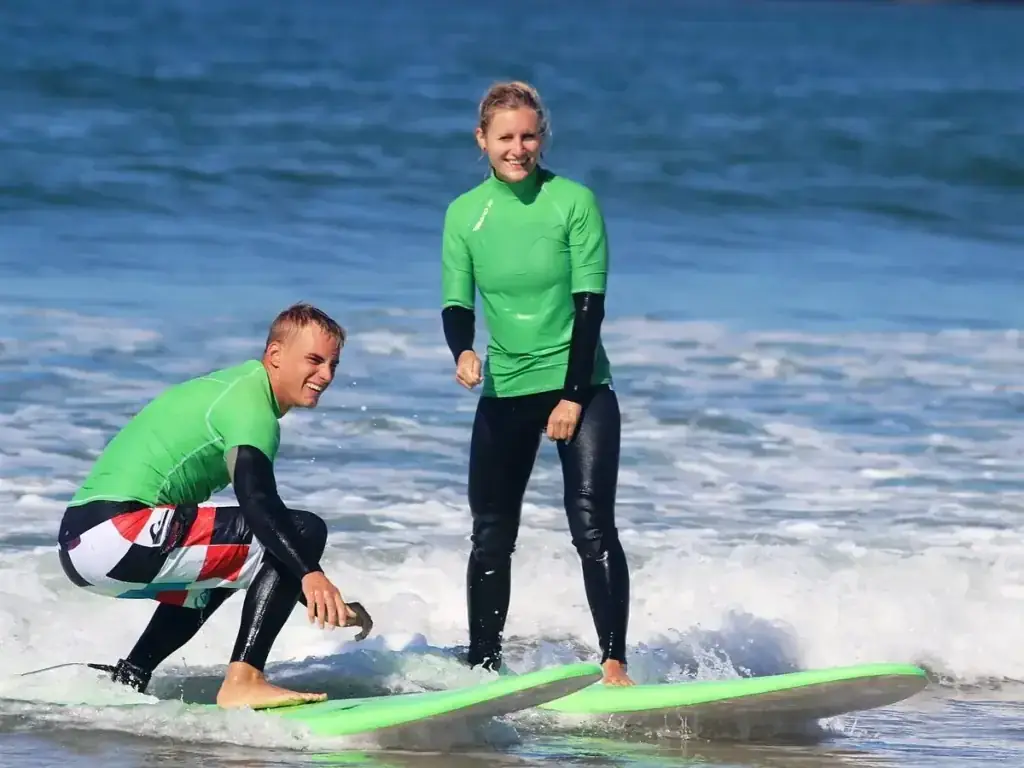
Evaluating how different operational models function under real-world conditions requires examining specific student profiles and training environments.
Scenario A: The Absolute Beginner with Water Anxiety
A first-time adult student seeks to learn wave riding but experiences mild anxiety in open water and deep ocean currents.
The optimal choice is a dedicated academy operating in a shallow, sandy cove with minimal current. The instructor conducts a comprehensive pre-session screening, explaining ocean dynamics and safety protocols.
Initial water work occurs in waist-deep water. The instructor holds the board tail to maintain stability, allowing the student to master balance without fighting currents.
Scenario B: The Intermediate Surfer Stagnation
An intermediate surfer with three years of self-taught experience struggles to generate speed down the line and execute functional rail turns.
The student enrolls in a private mobile coaching program or wave basin clinic utilizing high-speed video analysis. The instructor films three consecutive waves from land.
Video review reveals a narrow stance and improper shoulder rotation. The coach uses land-based surf skate drills to correct upper body movement, then returns to the water with two-way radio helmets to provide immediate timing cues.
Scenario C: Youth Summer Development Program
Parents seek a safe, structured multi-week summer ocean program for two children to build watermanship, ocean safety awareness, and wave riding technique.
The family selects a dedicated coastal academy offering structured youth camps with low student ratios (1:4 or better).
The curriculum integrates oceanography lessons, beach hazard identification, surf rescue basics, and progressive water instruction. Daily safety briefings and dedicated watercraft monitors ensure high safety margins throughout the multi-week program.
Planning, Cost, and Resource Dynamics
Selecting an instructional program involves analyzing direct tuition fees, rental costs, travel logistics, and hidden trade-offs.
Financial Investment Framework
Resource Management Dynamics
When planning an instructional program, students must consider several critical trade-offs:
-
Physical Conditioning Lead Time: Enrolling in intensive multi-day programs without prior paddle fitness leads to rapid physical fatigue, reducing the learning value of later sessions.
-
Gear Tailoring: Using generic, worn rental equipment hampers progress. Premier facilities provide soft-top and hard-top boards tailored to student height, weight, and skill level.
-
Seasonal Weather Windows: Booking coastal ocean lessons during off-peak seasons offers lower rates, but exposes students to colder water, larger swells, and unpredictable weather.
Tools, Strategies, and Support Systems
Modern surf instruction relies on advanced equipment, diagnostic software, and safety hardware to optimize learning and maintain safety standards.
1. Soft-Top Training Craft
Modern high-density foam boards equipped with soft rubber fins provide stability, high buoyancy, and impact protection, lowering injury risks during early wipeouts.
2. High-Frame-Rate Video Cameras
Land-based cameras recording at 60 to 120 frames per second allow coaches to break down foot placement, stance width, and weight distribution frame by frame.
3. Two-Way Radio Communication Helmets
Waterproof radio headsets worn by students enable coaches to deliver instant verbal corrections while the student is riding down the wave face.
4. Aerial Drone Monitoring
Low-altitude drones capture overhead footage, offering unique perspectives on lineup positioning, wave reading accuracy, and turn trajectories.
5. Surf-Skate Land Simulators
Carving skateboards with specialized front-truck assemblies replicate surfboard rail turns on dry land, allowing students to practice body mechanics repeatedly.
6. Personal Watercraft (PWC) Safety Sleds
Support jet-skis equipped with rescue sleds provide fast water transport and emergency response capabilities in heavy ocean environments.
Risk Landscape and Failure Modes
Ocean instruction carries inherent environmental hazards, physical risks, and instructional failure modes that demand systematic risk management.
Compounding Risk Drivers
Primary risk variables can compound rapidly in ocean environments:
-
Fatigue-Induced Panic: Physical exhaustion combined with strong offshore currents can trigger panic in inexperienced swimmers, escalating minor drift into rescue situations.
-
Instructional Overload: Instructors who deliver too many technical cues simultaneously cause cognitive paralysis, leading to awkward wipeouts and board loss.
-
Improper Lineup Selection: Placing beginner students in crowded or heavy wave lineups increases the risk of board collisions with other surfers.
Governance, Maintenance, and Long-Term Adaptation
Evaluating candidates for the best surf school united states benchmark requires checking operating permits, staff credentials, and safety standards.
Operational Audit Checklist
-
Municipal Permits & Insurance: Verify the facility holds valid commercial operating permits and comprehensive commercial liability insurance policies.
-
Instructor Credentials: Confirm staff hold recognized coaching certifications (e.g., ISA, USA Surfing) alongside CPR, First Aid, and Lifeguard credentials.
-
Equipment Maintenance Records: Inspect boards, wetsuits, and safety gear for wear, delamination, missing traction pads, or damaged fins.
-
Emergency Action Plans (EAP): Ensure the school maintains written, location-specific emergency protocols with designated medical evacuation procedures.
Long-Term Learning Adaptation Cycle
Quality instruction extends beyond single lessons, establishing an ongoing skill development cycle:
Measurement, Tracking, and Evaluation
Assessing student progress requires tracking both quantitative performance metrics and qualitative movement indicators over time.
Key Performance Indicators
-
Pop-Up Execution Time: Elapsed time from initial hands-on-deck placement to stable standing posture on the board.
-
Wave Catch Conversion Rate: The percentage of paddled-for waves successfully caught into clean rides.
-
Stance Width Consistency: Maintaining a stable stance with feet positioned over the board’s stringer and center of balance.
-
Ocean Awareness Score: Demonstrating independent ability to spot rip currents, evaluate wave sets, and navigate safely around other surfers.
Common Misconceptions and Oversimplifications
Myth 1: “A Great Surfer Is Automatically a Great Teacher”
Reality: Athletic capability does not guarantee pedagogical skill. Top instructors possess diagnostic patience, clear communication abilities, and structured teaching methodologies regardless of personal competition records.
Myth 2: “Smaller Boards Are Better for Fast Learning”
Reality: Riding undersized boards reduces stability and paddle speed, lowering wave catch counts. High-volume soft-top boards provide the flotation required to master balance mechanics.
Myth 3: “One Lesson Is Enough to Surfing Independently”
Reality: A single lesson teaches basic water safety and standing balance. Developing independent ocean literacy, wave reading skills, and line-up safety requires sustained instruction and practice.
Myth 4: “Wave Pools Eliminate the Need for Ocean Lessons”
Reality: Wave basins offer controlled environments for refining movement mechanics, but they cannot teach ocean navigation, current reading, or tide assessment.
Ethical, Practical, and Contextual Considerations
The expansion of commercial surf schools along popular coastal corridors raises important ethical, environmental, and community access considerations.
Lineup Crowding and Coastal Etiquette
High-volume commercial schools operating on public beaches can crowd surf lineups if student groups are not managed responsibly. Professional schools maintain low student ratios, teach proper lineup etiquette, and avoid operating in overcrowded zones to preserve access for local communities.
Environmental Stewardship
Coastal operations bear a responsibility to teach marine ecosystem protection. Educating students on dune preservation, marine life safety, and plastic pollution ensures that sports instruction supports long-term coastal conservation.
Conclusion
Finding the best surf school united states option requires matching student goals, skill levels, and safety expectations with the right facility structure and teaching approach. No single school satisfies every student profile. Beginners benefit most from shallow, sandy coves with low student ratios, while intermediate surfers gain more from video diagnostic studios and wave basin clinics.
By evaluating candidate institutions through pedagogical depth, instructor credentials, safety protocols, and environmental suitability, prospective students can invest wisely in their athletic development. Quality instruction transforms wave riding from a frustrating trial-and-error struggle into a safe, structured, and deeply rewarding lifelong pursuit.