How to Avoid Crowded Surf Spots: Complete Surfer’s Strategy Guide
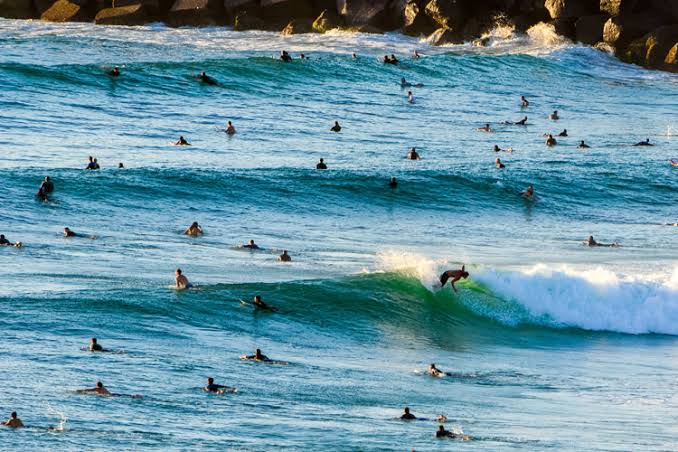
Surfing has experienced an unprecedented surge in global participation over the past decade. What was once a niche pursuit governed by local knowledge and seasonal obscurity has transformed into a mainstream athletic lifestyle. Digital mapping platforms, high-resolution forecasting applications, and real-time webcam feeds have eliminated the traditional barriers to entry that once protected remote breaks. Consequently, coastal congestion has shifted from a localized issue at iconic point breaks to a systemic reality across nearly every accessible coastline.
Navigating this reality requires moving past simple ideas about timing or location. Finding uncrowded waves is rarely a matter of luck or simply waking up before dawn. Instead, it demands a methodological approach rooted in oceanography, coastal geometry, behavioral dynamics, and spatial analysis. Surfers who consistently find uncrowded waves do so by understanding the interplay between atmospheric conditions, bathymetry, and human habit.
This guide outlines a clear framework for reading lineups and predicting crowd patterns. By assessing environmental variables and crowd behavior, surfers can systematically reduce crowd friction. The goal is not merely to discover secret waves, but to develop an adaptable strategy for finding quality surf away from dense crowds.
Understanding “How to Avoid Crowded Surf Spots”
Learning how to avoid crowded surf spots is often misunderstood as a simple search for secret locations. Novice surfers frequently assume that experienced locals possess private maps of untouched waves. In reality, modern satellite imaging and crowd-sourced intelligence have made geographical secrets increasingly rare. True avoidance relies on dynamic timing and environmental interpretation rather than spatial exclusivity.
The Dynamics of Lineup Congestion
Crowds gather because human behavior follows predictable patterns. Most surfers operate under fixed schedules dictated by work, daylight, comfort, and popular forecasting models. When a swell arrives, standard forecasting platforms issue identical alerts to tens of thousands of users simultaneously. This creates a synchronized influx of surfers to the highest-rated spots.
Understanding this dynamic allows observant surfers to target conditions that fall just outside mainstream preferences. A location rated slightly lower on a forecasting app often offers vastly superior wave counts due to lower crowd density.
The Limits of Simple Tactics
Common advice usually focuses on single variables. Statements like “surf at dawn” or “walk farther down the beach” offer basic utility, but they fail when applied universally. Dawn patrols at popular urban breaks are frequently as congested as mid-morning sessions. Similarly, walking down a stretch of beach yields no benefit if the offshore bathymetry cannot support a functional lineup.
Effective strategies require combining multiple variables simultaneously. Surfers must weigh wind shifts, tide curves, bathymetric tolerance, and local work patterns together. Isolating any single factor usually leads to missed opportunities or unexpected crowd concentration.
Technical and Physical Compromises
Finding uncrowded surf almost always involves trade-offs. The cleanest, most symmetrical point breaks naturally attract the highest concentration of talent and numbers. Surfing with fewer people often means accepting sub-optimal conditions.
This might include handling cross-shore winds, navigating shifting beach break peaks, or managing heavy shorebreak. Surfers must assess whether their technical ability aligns with the demands of raw, unrefined wave setups.
Deep Contextual Background
The Digitization of Coastal Knowledge
Historically, local knowledge was acquired through years of direct observation, trial, and personal mentorship. Surfers tracked swell directions, tide cycles, and wind patterns using physical notebooks and local weather charts. This creates a natural filter that distributed crowds slowly and unevenly across regional coastlines.
The rapid development of digital surf forecasting platforms altered this distribution model. Algorithms now synthesize complex meteorological data into simplified visual ratings. Color-coded quality scores standardize user interpretation globally. As a result, crowd dispersal has transitioned from organic distribution to algorithmic aggregation.
Infrastructure and Equipment Evolution
Innovations in wetsuit technology have expanded the geographical and seasonal boundaries of the sport. Modern cold-water gear enables high-performance surfing in sub-freezing temperatures, opening previously inaccessible northern and southern latitudes. Concurrently, improved road networks, off-road vehicles, and affordable international travel have eliminated geographic insulation.
Board design has also broadened the demographic profile of the lineup. Mid-length crafts, high-volume softboards, and hydrofoils allow individuals of varying fitness levels to access waves across different swell types.
The Urbanization of Surfing Hubs
Coastal real estate development has concentrated surfing populations around major metropolitan centers and dedicated surf towns. High density in these coastal corridors creates localized pressure points where supply cannot meet demand.
Understanding these historical shifts reinforces a key truth: crowds are a structural reality of modern coastal geography. Mitigating their impact requires deliberate, structured strategy rather than reliance on outdated spatial norms.
Conceptual Frameworks and Mental Models
The Friction of Distance Model
Borrowed from spatial geography, this model suggests that crowd density decreases exponentially as physical effort, expense, or access difficulty increases. The majority of surfers select spots that offer immediate parking, simple paddle-outs, and comfortable amenities.
Adding physical friction—such as a forty-minute hike, a long paddle across a channel, or a multi-hour drive—significantly filters the prospective crowd.
The Window of Marginal Conditions
Mainstream forecast platforms optimize their ratings for textbook perfection: light offshore winds, mid-period groundswells, and gentle tide transitions. The Window of Marginal Conditions model deliberately seeks out parameters flagged as sub-optimal by automated systems, yet remaining highly rideable for skilled surfers.
-
Short-Period Swells: High-frequency swell trains (7–9 seconds) produce erratic, shifting peaks that distribute a crowd across wide beach breaks rather than concentrating them at a single point.
-
Tidal Extremes: Surfing during full high or drain-dry low tides often exposes raw, challenging features that deter intermediate surfers.
-
Onshore Wind Transitions: Early-stage onshore winds degrade wave symmetry slightly, but they immediately clear out packed lineups while leaving functional wave faces.
The Temporal Offset Strategy
Human routines are extraordinarily consistent. Work schedules, meal times, and circadian rhythms dictate predictable lulls in lineup density.
The Temporal Offset strategy focuses on exploiting these transition windows. Surfing during mid-day heat or the exact shift between morning and afternoon schedules offers consistent, low-density opportunities.
Key Categories of Uncrowded Wave Environments
Selecting where to surf requires evaluating specific trade-offs across different wave types and operational environments.
Shiftable Beach Breaks
Continuous sandbars along open coastlines lack a single fixed takeoff point. Wave energy spreads across hundreds of meters, requiring surfers to constantly move and read the ocean.
While this environment demands continuous paddling fitness, it prevents the localized clustering typical of point and reef breaks. The primary challenge lies in managing fatigue and positioning along shifting sand structures.
Remote Access Reefs
Reef setups located away from coastal infrastructure require deliberate planning to access. Transportation may involve off-road vehicles, personal watercraft, or extended hikes along rugged terrain.
These spots often deliver high-quality, predictable waves, but they carry elevated safety risks. Medical evacuations from remote reefs are slow and complex, demanding self-reliance and complete safety equipment.
Wind-Exposed Setups
Mainstream surfing culture prioritizes glassy or strictly offshore conditions. Embracing spots exposed to side-shore or light onshore winds unlocks uncrowded lineups.
Modern board design can compensate for chopped water faces, allowing experienced surfers to convert overlooked conditions into productive sessions.
Detailed Real-World Scenarios
Scenario 1: The Metropolitan Groundswell
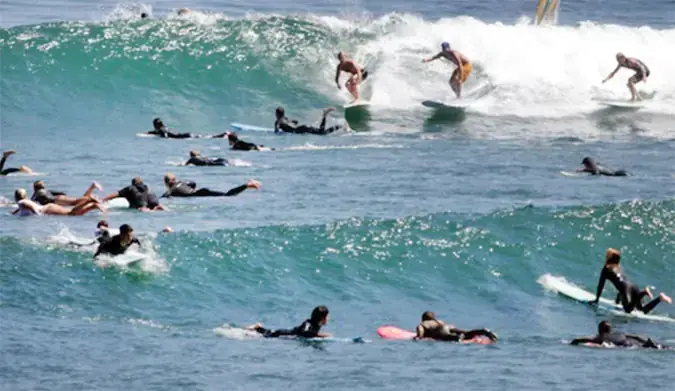
A powerful, long-period groundswell hits a major coastal city on a clear Saturday morning. Regional forecasts display bright green ratings across all accessible point breaks.
-
Primary Constraint: Extreme population density within a sixty-minute drive radius.
-
Strategic Decision: Avoid all primary point and reef breaks completely. Target an exposed, wide-open beach break capable of handling high swell energy.
-
Execution: Accept shorter ride lengths in exchange for maximum wave count. Position along secondary sandbars that require a longer paddle.
-
Failure Mode: Attempting to surf a primary point break during the dawn window under the assumption that early arrival guarantees a spot.
Scenario 2: The Mid-Week Onshore Shift
A moderate swell combines with early afternoon onshore sea breezes along a suburban coastline. The forecast quality rating drops significantly at 1:00 PM.
-
Primary Constraint: Time limitations due to standard working hours.
-
Strategic Decision: Capitalize on the immediate departure of casual surfers as the wind switches.
-
Execution: Enter the water thirty minutes after the wind turns onshore. Focus on broken-up reef sections or sheltered nooks that clean up under cross-shore airflow.
-
Second-Order Effect: Lower crowd pressure allows for relaxed positioning, higher wave experimentation, and reduced stress in the lineup.
Scenario 3: The Remote Hike-In Setup
A high-quality reef break sits three miles from the nearest paved parking area along a steep, unmaintained coastal trail.
-
Primary Constraint: Physical exhaustion combined with safety risks in an isolated environment.
-
Strategic Decision: Commit to an extended pack-in session carrying emergency medical supplies, adequate hydration, and alternative equipment options.
-
Execution: Time the hike to arrive at the reef during an unrecommended tide phase, targeting the window where the break transitions into prime conditions.
-
Failure Mode: Underestimating gear requirements or suffering an injury far from emergency support services.
Planning, Cost, and Resource Dynamics
Systematically avoiding crowds requires allocating time, capital, and physical energy. The following matrix illustrates the structural investments required across different approach models.
Direct Capital Expenditures
Reaching isolated ocean environments often requires specialized equipment. Investing in high-grade 5/4mm or 6/5mm wetsuits opens northern latitude coastlines during winter months when local populations drop to zero.
Similarly, acquiring reliable off-road transportation or personal watercraft transforms inaccessible stretches of coast into viable options. These capital investments trade financial resources directly for lower crowd density.
Opportunity Costs and Time Allocation
Seeking uncrowded waves involves a fundamental trade-off: spending time paddling, driving, or walking instead of spending time actually riding waves. A surfer who spends two hours driving to a remote spot may only get an hour of water time.
However, that single hour may yield ten uncrowded waves, whereas three hours at a local break might yield only two contested rides. Evaluating this ratio is central to effective session planning.
Tools, Strategies, and Support Systems
Modern technology can be adapted to identify low-density opportunities when combined with analytical observation.
Advanced Meteorological Mapping
Relying solely on simplified summary scores on forecast apps guarantees following the crowd. Analyzing raw atmospheric models—such as NOAA’s GFS or the European Centre for Medium-Range Weather Forecasts (ECMWF)—allows surfers to identify localized microclimates.
Isolating minor gaps in regional wind systems often reveals brief windows of clean conditions at unsheltered breaks.
Bathymetric and Topographic Analysis
Navigating digital bathymetric charts provided by maritime agencies reveals underwater features that alter swell behavior. Subtle canyons, deep-water ledges, and changing river mouth deltas focus swell energy into unexpected zones.
Comparing these nautical charts with high-resolution satellite imagery helps pinpoint offshore reefs that function without direct shoreline access.
Personal Operational Checklists
Developing systematic pre-session checklists helps remove emotional decision-making. These checklists should evaluate real-time factors systematically:
Risk Landscape and Failure Modes
Over-Estimation of Personal Capability
Seeking solitude frequently leads surfers into raw, unpatrolled ocean environments. A minor equipment failure, such as a snapped leash or broken fin, transforms from a minor inconvenience at a crowded urban break into a severe survival situation at an isolated outer reef.
Surfers must evaluate their swimming fitness, ocean knowledge, and self-rescue capabilities before entering uncrowded, hazardous setups.
Environmental Degradation Risks
Accessing remote coastal zones can unintentionally damage sensitive ecosystems. Uncontrolled vehicle access through coastal dunes accelerates erosion and destroys fragile vegetation.
Surfers targeting isolated breaks must adopt low-impact travel techniques, stick to established pathways, and pack out all waste to protect pristine coastal environments.
Localized Safety Dynamics
Arriving at an unfamiliar, isolated break requires heightened awareness of local cultural dynamics and safety protocols. Entering a sensitive lineup without assessing existing social structures can create unnecessary friction.
Respectful observation, adherence to universal lineup etiquette, and clear communication remain essential, regardless of how few people are in the water.
Governance, Maintenance, and Long-Term Adaptation
Building a Regional Spatial Map
Sustained success in finding uncrowded waves requires systematic documentation. Maintaining a private logbook tracking swell directions, periods, wind angles, and tide levels builds an invaluable personal database over time.
Recording how specific spots perform under varying conditions helps identify non-obvious patterns that automated algorithms miss.
Adjusting to Dynamic Sand and Coastline Changes
Coastal environments are inherently dynamic. Winter storms, river discharge, and longshore drift continuously reshape sandbars and coastal access routes.
A spot that proved completely uncrowded and high-quality one season may become unusable the next. Periodically re-surveying known coastlines keeps personal spatial maps accurate and up to date.
Measurement, Tracking, and Evaluation
Evaluating the success of a crowd-avoidance strategy requires tracking clear metrics beyond basic wave counts.
Quantitative Metrics
-
Uncontested Wave Ratio: The percentage of waves caught without competing against other surfers in the immediate takeoff zone.
-
Wave Efficiency Rate: Total rides completed per hour relative to total ocean time expended, including travel and paddle out.
-
Crowd Density Index: The average number of surfers positioned within a fifty-meter radius of the primary takeoff point.
Qualitative Signals
-
Freedom of Positioning: The ability to adjust takeoff lines without interfering with or being blocked by other craft.
-
Reduced Decision Stress: The mental clarity gained from reading ocean swells without worrying about immediate collisions or priority disputes.
Common Misconceptions and Oversimplifications
Myth 1: Dawn Patrol Always Guarantees Solitude
The belief that arriving at first light ensures an empty lineup is obsolete in most populated regions. Automated alarm systems, early work schedules, and shared popular wisdom make the 05:30 to 07:00 window extremely crowded at accessible urban breaks.
Surfers often find significantly lower crowd density by targeting mid-day temporal windows or late afternoon wind shifts instead.
Myth 2: Secret Spots Are the Only Solution
Relying entirely on discovering hidden, unnamed spots creates an unsustainable approach. High-resolution mapping tools mean true geographical secrets are rare.
Long-term success comes from understanding how variables interact across known breaks rather than searching endlessly for unmapped locations.
Myth 3: High Forecast Ratings Mean Better Sessions
Forecast ratings measure atmospheric and oceanographic perfection, not overall session quality. A five-star rating at a popular break usually produces an aggressive, overcrowded lineup where catching quality waves becomes difficult.
Conversely, a two-star rating at a secondary break often provides higher wave counts and a far better experience overall.
Ethical, Practical, and Contextual Considerations
The pursuit of uncrowded waves carries clear ethical responsibilities. Sharing exact GPS coordinates or real-time media of sensitive, low-capacity breaks online rapidly accelerates overcrowding and strains local infrastructure. Practicing digital discretion protects fragile coastal environments and respects local communities.
Additionally, venturing into isolated regions requires strict self-reliance. Leaving trash, disturbing wildlife, or requiring preventable emergency rescues impacts local resources. Respecting coastal environments ensures these spaces remain sustainable and enjoyable for everyone.
Conclusion
Mastering how to avoid crowded surf spots requires moving past basic formulas and embracing a dynamic, adaptable strategy. Coastal crowds are an established feature of modern surfing, driven by digital technology, better equipment, and demographic growth. Mitigating their impact requires a methodical approach that blends oceanographic reading, spatial awareness, and behavioral observation.
By looking beyond simplified forecast ratings, embracing marginal conditions, investing physical effort, and timing sessions strategically, surfers can find quality waves away from dense lineups. Solitude in the ocean is rarely discovered by accident—it is created through careful planning, flexible thinking, and a deep respect for the coastal environment.