Managing Surf Travel Gear Damage: A Comprehensive Damage Protocol
How to Manage Surf Travel Gear Damage. Navigating international transit with fragile, high-value surf equipment represents one of the most complex logistical challenges in modern sports travel. Unlike standard luggage, surfboards and technical ocean gear are built with delicate strength-to-weight ratios that make them susceptible to structural damage during baggage handling. The combination of baggage handlers, pressure changes, rough roads, and remote surf environments creates a continuous threat to equipment integrity.
Managing gear damage effectively requires moving beyond passive hope and basic bubble wrap. Surfers must understand composite materials, repair chemistry, airline liability rules, and field repair strategies. Equipment failures during remote surf trips do not merely cause financial inconvenience; they can disrupt entire itineraries, ruin wave opportunities, and compromise personal safety in heavy ocean conditions.
Establishing an operational framework transforms gear protection from a series of frantic, reactive fixes into a systematic risk-management discipline. This guide outlines pre-flight packing, field repairs, claim procedures, and long-term equipment preservation to protect your gear.
Understanding “how to manage surf travel gear damage”
Mastering how to manage surf travel gear damage requires a multi-stage approach that integrates damage prevention, field repairs, and legal recovery. Equipment care begins long before arriving at the airport terminal and extends far beyond applying solar-cure resin to a crushed rail.
The Three Operational Phases
Preventative packing uses high-density closed-cell foam, rigid nose guards, and strategic weight distribution within heavy-duty travel bags. This layer absorbs impact energy, distributes point loads, and minimizes crushed rails or snapped stringers during transit.
Transit audits involve inspecting equipment immediately upon arrival at airport baggage areas. Documenting damage before leaving customs establishes clear airline liability and supports property claims.
Field repair mechanics allow travelers to perform structurally sound repairs in remote locations lacking professional ding repair services. Using appropriate chemical resins ensures gear remains watertight and surfable without compromising structural integrity.
Common Misunderstandings in Gear Protection
A frequent mistake involves treating all surfboard foam cores identically during field repairs. Applying standard polyester resin to an Expanded Polystyrene (EPS) core triggers a rapid chemical reaction that melts the foam instantly. Epoxy resin must always be used on EPS cores.
Another misconception is relying solely on fragile airline baggage tags or verbal fragile warnings. Automated conveyor systems and baggage handlers process gear based on bag dimensions and weight, ignoring fragile stickers entirely. Robust internal packing remains your only real defense against impact damage.
Balancing Structural Weight and Travel Protection
Ocean travel requires balancing gear weight limits against structural padding needs. Airlines enforce strict weight thresholds, penalizing oversized or heavy board bags with high fees.
Overpacking a bag with heavy blankets or towels increases the risk of exceeding weight limits and receiving rough handling. Using purpose-built, lightweight foam pipe insulation and tailored board socks provides superior protection while keeping overall weight manageable.
Deep Contextual Background
The Materials Revolution and Equipment Vulnerability
Surfing equipment has evolved significantly over the past half-century. Early wood and early polyurethane (PU) boards were heavy but physically resilient. The modern shift toward ultra-lightweight polyurethane foam, Expanded Polystyrene (EPS), carbon fiber, and epoxy resins has dramatically enhanced wave-riding performance.
These performance gains come at the cost of structural durability. Modern high-performance shortboards feature thin fiberglass glassing schedules, making them prone to impact dings, stress fractures, and crushed tails during transit.
Evolution of Airline Baggage Handling Infrastructure
Automated sorting systems, high-speed conveyor belts, and compact cargo holds have increased processing speeds across global aviation networks. However, these mechanized systems introduce distinct structural hazards for long, awkward cargo like surfboard bags.
Long board bags often catch on conveyor belt turns, slide off sorting ramps, or end up beneath heavy hard-shell suitcases in cargo holds. Understanding these physical hazards allows travelers to reinforce vulnerable zones, such as the nose, tail, and rails.
Global Logistics and Remote Supply Chain Gaps
Traveling to remote surf destinations like the Mentawai Islands, outer Fiji, or rural West Africa presents major repair challenges. Remote regions rarely have professional ding repair shops or specialty composite materials available.
Surfers operating in these isolated environments must carry complete self-sufficiency kits. Lacking appropriate resin, fiberglass cloth, or sandpaper can convert a minor rail ding into a trip-ending gear failure.
Conceptual Frameworks and Mental Models
The Impact Absorption and Dissipation Model
This mechanical model explains how protective padding mitigates external shock forces during baggage handling.
Direct impacts deliver high kinetic energy to small surface areas, causing crushed foam or fractured fiberglass. High-density closed-cell foam distributes point loads across wider areas, reducing localized damage.
Rigid nose and tail guards absorb edge impacts, preventing crushed fiberglass fibers and preserving the board’s hydrodynamics.
The Watertight Integrity Spectrum
Maintaining watertight integrity is critical for composite surfboard structures. Water entering a foam core degrades structural strength and adds unwanted weight.
Sealed Surface Sheeting
Intact fiberglass and epoxy skin that completely prevents water entry into the core material.
Micro-Fractures and Stress Cracking
Fine spiderweb cracks in the outer resin coat that allow gradual water intrusion over multiple surf sessions.
Open Delamination and Exposed Core
Fractured fiberglass exposing raw foam directly to saltwater, causing rapid foam saturation and core rot.
The Repair Velocity Index
This model measures the operational speed of executing watertight field repairs relative to local environmental constraints.
Solar-cure resins allow rapid repairs under direct sunlight, making them ideal for quick fixes between surf sessions. Two-part epoxy or polyester resins require precise mixing ratios and long cure times, but deliver superior structural strength for major repairs.
Key Categories of Equipment Failure and Structural Damage
Managing gear damage requires identifying specific structural failures and applying targeted repair strategies.
Rail Crushes and Fractures
Rail dings occur when lateral forces compress the curved edges of a surfboard. Crushed rails breach the outer glassing layer, exposing internal foam to water intrusion.
Field repairs require scraping away crushed fiberglass, drying the foam thoroughly, applying UV-cure resin with glass mesh, and sanding the area smooth to restore clean water flow.
Snapped Stringers and Hull Buckles
Buckles happen when heavy bending forces exceed the flex limit of the wood or carbon stringer. A snapped stringer destroys structural integrity, causing the board to flex excessively under foot pressure.
Fixing a buckled board in the field requires setting internal reinforcement splints, applying heavy fiberglass cloth, and curing with structural two-part epoxy. Major buckles usually require professional repair after returning home.
Fin Box Stress Fractures
Fin box failures occur when lateral impacts torque the fins, cracking the surrounding fiberglass casing. Surfing with a cracked fin box allows water into the tail core and risks losing the fin box entirely.
Field repairs require removing the fin, clearing damaged glass, packing structural epoxy resin around the box casing, and wrapping the repair with heavy fiberglass cloth.
Detailed Real-World Scenarios
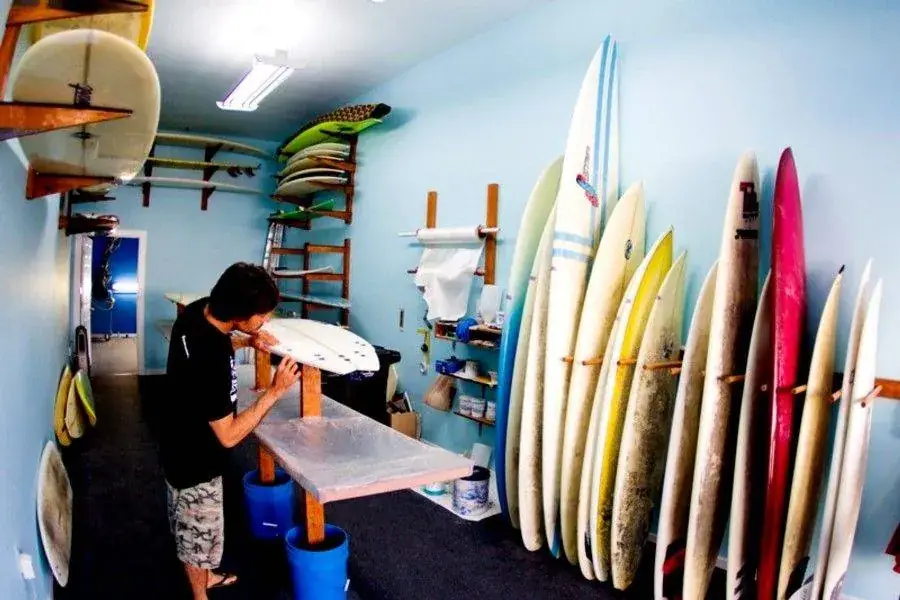
Scenario 1: Rail Fracture Upon Arrival in Remote Location
A surfer arrives in an isolated island region and discovers a crushed rail on their primary board during airport unpacking.
-
Primary Constraint: Limited access to professional repair shops and a major swell arriving in twelve hours.
-
Strategic Decision: Perform an immediate field repair using solar-cure UV resin, Q-cell filler, and coarse sandpaper.
-
Execution: Scrape away crushed glass, fill core voids with Q-cell paste, seal with UV resin under direct sunlight, and sand flat.
-
Failure Mode: Surfing without fixing the rail, saturating the foam core with saltwater and ruining the board permanently.
Scenario 2: Snapped Fin Box During Transit
An airline baggage drop crushes a side fin box on a high-performance shortboard, cracking the surrounding glassing layer.
-
Primary Constraint: The fin box is loose and unable to support fin pressure during turns.
-
Strategic Decision: Re-anchor the fin box casing using high-strength two-part epoxy resin reinforced with fiberglass cloth.
-
Execution: Remove the fin, clean fractured glass away from the box rim, pack structural epoxy around the box base, wrap with fiberglass cloth, and let cure for twenty-four hours.
-
Second-Order Effect: Restores structural stability to the fin box, allowing safe surfing for the remainder of the trip.
Scenario 3: Wetsuit Neoprene Seam Tear
A traveler tears a major shoulder seam on their cold-water wetsuit while packing, compromising thermal protection before a cold-water surf trip.
-
Primary Constraint: Cold water temperatures make surfing impossible with a leaking wetsuit seam.
-
Strategic Decision: Perform an emergency seam repair using black neoprene contact cement and an internal reinforcement patch.
-
Execution: Clean and dry the damaged seam, apply neoprene cement to both edges, press firm for two minutes, and apply an iron-on neoprene patch inside.
-
Failure Mode: Using standard duct tape, which dissolves quickly in cold saltwater and leaves a messy residue.
Planning, Cost, and Resource Dynamics
Managing gear protection requires balancing equipment investments against travel risks and potential repair costs.
Unbundling Airline Liability and Claims
Airline baggage liability rules vary across international carriers and travel regions. Under the Montreal Convention, carrier liability for damaged luggage is capped at specific financial limits, which may not cover custom surfboards.
Filing successful claims requires thorough documentation. Travelers should take time-stamped photos of equipment before packing, retain bag tags, and secure an official Property Irregularity Report (PIR) before leaving the arrivals hall.
Managing Insurance Policy Deductibles
Specialized travel insurance policies offer coverage for sports equipment damage during transit. However, travelers should review policy details carefully regarding deductibles, wear-and-tear exclusions, and claims requirements.
High deductibles can make filing small repair claims impractical. Maintaining a complete field repair kit often proves more cost-effective for minor dings.
Tools, Strategies, and Support Systems
Preparing for long-distance travel involves assembling high-grade protective materials and field repair supplies.
Purpose-Built Travel Bag Architecture
High-end surfboard travel bags feature heavy-duty ripstop nylon, high-density closed-cell foam padding, heat-reflective internal linings, and reinforced sidewalls.
Choosing bags with interior tie-down straps holds boards securely in place, preventing internal friction and impact damage during transit.
The Ultimate Field Repair Kit Assembly
A comprehensive repair kit ensures complete self-sufficiency when traveling in remote coastal areas:
Component 1: Specialty Resins
Carry both UV-cure solar resin tubes and small two-part epoxy resin kits to treat various foam core materials safely.
Component 2: Structural Reinforcements
Pack high-density Q-cell filler powder, multi-ounce fiberglass cloth swatches, and structural carbon fiber strip patches.
Component 3: Preparation Tools
Include multi-grit sandpaper sheets (80, 120, 220, and 400 grit), razor blades, masking tape, and mixing cups.
Component 4: Neoprene & Hardware Tools
Pack neoprene repair cement, replacement fin screws, a multi-tool fin key, leash strings, and heavy-duty ding tape.
Risk Landscape and Failure Modes
Thermal Expansion and Delamination Hazards
Leaving board bags exposed to direct sunlight or high temperatures in closed vehicles causes rapid air expansion within foam cores. This pressure build-up can detach the outer fiberglass skin from the foam core, causing severe delamination.
Using heat-reflective travel bags, loosening Gore-Tex air vents, and keeping equipment in shaded areas prevents heat-induced delamination.
Saltwater Corrosion and Hardware Seizure
Saltwater residue causes rapid oxidation on metal zippers, fin screws, and leash swivels. Corroded bag zippers freeze shut, while seized fin screws strip easily during board assembly.
Rinsing zippers and hardware with fresh water after every session and applying marine silicone lubricant prevents corrosion and hardware failure.
Over-Tightening Internal Bag Straps
Tightening internal bag straps excessively compresses curved rails against hard fin boxes or adjacent board edges.
This localized pressure can crack fiberglass skins during transit. Straps should be secured firmly to prevent board movement without crushing delicate rail profiles.
Governance, Maintenance, and Long-Term Adaptation
Post-Trip Equipment Maintenance Logs
Maintaining long-term equipment integrity requires thorough post-trip inspections and maintenance tracking. Surfers should document repairs, stringer flex trends, and fiberglass fatigue.
Tracking these details ensures boards receive professional touch-ups between major international trips.
Monitoring Airline Policy Updates
Airline baggage policies, weight limits, and surfboard fee structures change frequently across international carriers.
Checking sporting equipment guidelines before booking flights helps travelers avoid unexpected fees or strict bag size limits at check-in counters.
Measurement, Tracking, and Evaluation
Evaluating equipment care involves tracking quantitative physical metrics alongside qualitative gear performance indicators.
Quantitative Metrics
-
Board Weight Gain: Measuring board weight before and after trips detects hidden water retention inside the foam core.
-
Damage Incident Frequency: Tracking the ratio of damaged boards relative to total flights identifies weak packing methods.
-
Repair Costs: Monitoring overall maintenance expenses helps evaluate the return on investment for high-end travel bags.
Qualitative Signals
-
Flex Dynamics: Assessing whether a surfboard maintains its original flex and responsiveness after structural rail or deck repairs.
-
Visual Surface Quality: Inspecting repairs to ensure smooth, hydrodynamic finishes that minimize drag in the water.
Common Misconceptions and Oversimplifications
Myth 1: Bubble Wrap Provides Complete Impact Protection
Travelers often assume wrapping surfboards in standard air-bubble wrap guarantees complete protection against transit damage.
Standard bubble wrap pops under heavy loads, offering minimal protection against high-impact drops. High-density, closed-cell polyethylene foam provides far superior impact absorption.
Myth 2: Epoxy Resin Works Equally Well on Polyurethane Foam
Many assume epoxy resin is intended only for EPS foam cores and performs poorly on traditional Polyurethane (PU) foam.
In reality, high-grade epoxy resin bonds exceptionally well to both PU and EPS foam cores, offering superior tensile strength and flex characteristics compared to standard polyester resin.
Myth 3: Board Bags Do Not Require Fresh Water Rinsing
Surfers frequently leave salt spray on travel bag fabric and metal zippers, assuming board bags require no routine cleaning.
Salt crystals corrode metal zipper sliders quickly, causing them to freeze and break. Rinsing bag zippers with fresh water extends their operational life significantly.
Ethical, Practical, and Contextual Considerations
Managing gear damage responsibly involves disposing of composite chemical materials safely in remote coastal environments.
Abandoned resin containers, fiberglass scraps, and chemical solvents pollute delicate marine ecosystems and overload limited waste facilities in island regions.
Responsible travelers pack out all repair waste, store chemical solvents in sealed containers, and dispose of hazardous materials at proper recycling facilities upon returning home.
Respecting local ecosystems ensures these world-class coastal destinations remain clean and preserved for future generations.
Conclusion
Understanding how to manage surf travel gear damage requires integrating careful packing habits, clear repair knowledge, and diligent documentation. Global surf travel exposes delicate composite equipment to continuous logistical risks across airlines, roads, and ocean environments.
By investing in high-density closed-cell padding, assembling comprehensive field repair kits, using appropriate resin chemistries, and completing thorough post-flight inspections, travelers protect their equipment investment. Proactive gear management ensures your surfboards arrive watertight, structurally sound, and ready for every wave opportunity.